

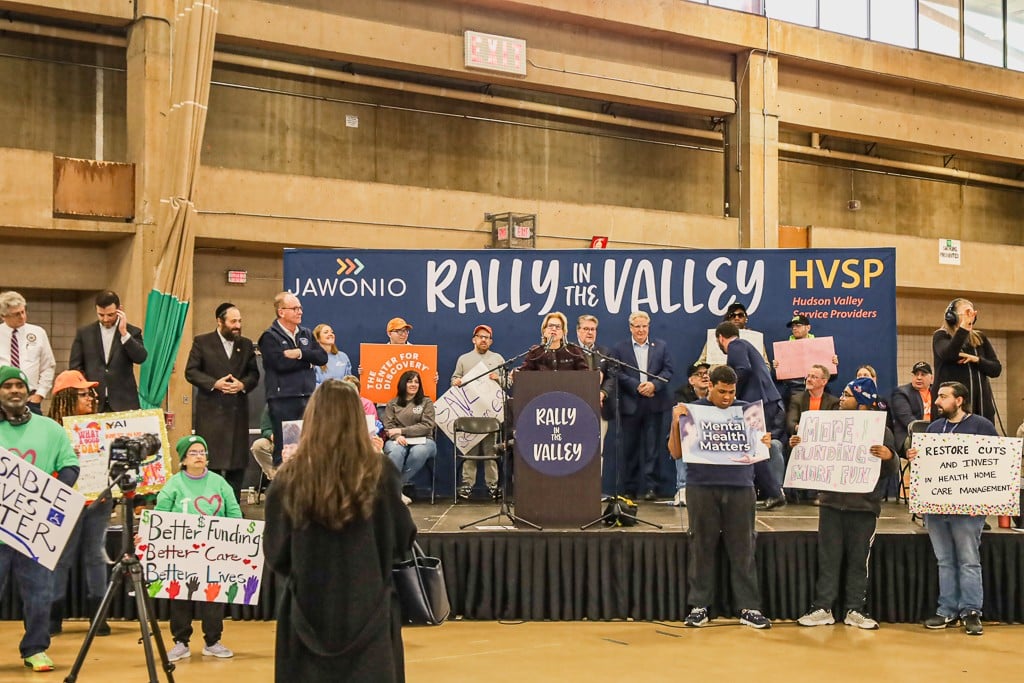
 Working in human services for the past three years has been a true learning experience. Even more significant was the opportunity to attend a rally supporting investments in the disability services sector. On Friday March 13, I joined Elise Olsen, Vladimir Noel, Tuvia Naftali, and Edward Richardson, self-advocates traveling with Onika Bancroft, Direct Support Professional (DSP), from their Day Services location in Freeport. We were all very excited.
Day, Residential, and Prevocational Services (PreVoc) among others, are known as Home- and Community-Based Services (HCBS). These programs are designed to help people with disabilities live and function as independently as possible in their communities. In New York State, HCBS programs are offered through the Office for People With Developmental Disabilities (OPWDD), a state agency funded primarily by Medicaid and supplemented by state budget allocations.
There are many components working independently to leverage these services. What results is a complex system burdened by strict state and federal regulations. For people living within it, navigating the system can get overwhelming very quickly.
Everything from becoming eligible for services, accessing them, sustaining them, and changing them as needs evolve is a multi-layered process. What makes it more challenging is that requirements often change depending on the political climate. However, over 85% of people who benefit from HCBS programs are long-term services and supports users—people living with chronic illness or permanent disability.
As a person living with autism, my brother Ryan is one of those people. He receives PreVoc and participates in Self-Direction, a program that gives him more choices on where to apply his waiver services. Helping him access services these last few years has taught me how difficult it is for people with disabilities to gain the supports they need.
To manage their services, people with disabilities need advocates, a team, and people who genuinely care for their wellbeing. Joining Elise, Tuvia, Vladimir, and Edward at the rally in Rockland helped me realize that people also need their voices heard.
I’ve spoken with all the self-advocates before, but during the ride, what struck me most is how deep the bond is between a person receiving services and their support staff. I was surprised at how much I learned about everyone. Tuvia is social and outgoing. He loves the Long Island Railroad (LIRR), so much so that he knows every stop by heart.
He announced every station we drove past while on the highway. It was hilarious. Tuvia takes pride in being a good advocate. From my understanding, he advocates to support his staff.
Elise feels the same way. She’s a woman who truly values the people who support her. People she can joke around with, ask for advice, and discuss life. People with whom she feels seen.
At the rally I saw more of the same, among the testimonies of self-advocates, staff members, politicians, and organization leaders, thousands of people supported and their staff—likely sharing a bond just as deep. It made me think of my brother and his relationship with his staff. He attends PreVoc twice a week on Tuesdays and Thursdays. They pick him up and head out to either volunteer at a food pantry or develop job skills at businesses.
Every now and then, I’ll receive texts from his staff. I’ve never met her, but Ryan tells me her name is Maria, and Maria tells me Ryan is hilarious—news to me honestly. She shares how he’s always joking and pulling pranks, like hiding behind the door during pick-up or pretending he’s upset with Maria when she arrives late.
 I know Ryan as my little brother, the one who forgets to tell me he’s out of groceries, until I’m out of groceries because he ate them all. Then, I have to remind him—again—to send me his grocery list because he can’t seem to remember that he needs to tell me when he’s out of groceries.
I know Ryan as the one who runs up my credit card balance with food delivery orders and somehow taught himself to pull money out of my bank account via the app to refill the debit card he uses while at PreVoc or art class. Just $50, once or twice a month, just enough that I don’t notice, maybe it’s because when he asked for $100, I said it was too much.
To his staff, he’s Ryan who, “did a great job today greeting customers.” Or Ryan who, “worked well with his partner doing a scavenger hunt at the grocery store.” Or even Ryan who, “filled out a job application all by himself and barely needed any prompting.”
Maybe that’s the purpose of having support staff. People who can be there and supplement a person’s areas of need. To me, he’s the forgetful and slightly annoying person who refuses to send me his grocery list when things run out, but maybe that’s an area of need magnified by disability and I can’t see that.
I’m his sister, and to the best of my ability, I can be caring, supportive, and administrative; but I may never truly be able to support his needs like someone tasked to do so. Like someone trained to help him be the best that he can be, gently and without judgement.
Seeing the self-advocates on the way to the rally interact with Onika, freely asking questions, being themselves and receiving support, helped me understand how support staff care for people with disabilities. Care professionals work with people at their capacity. The goal isn’t necessarily to teach or habilitate them, as needs may change. The goal, especially when it comes to HCBS programs, is to allow a person to engage with their community as much as possible. To be as independent as possible, however uniquely that presents itself.
The unfortunate reality of disability advocacy is that investments for programs like Medicaid, which funds HCBS, seem to be always in flux. Health and human services are constantly under threat of divestment or restructuring, as if at some point these services will no longer be needed. This directly impacts the long-term services and supports users that rely on them.
Other permanent structures, like roads and bridges, receive regular investments and upgrades. It’s expected that as time passes, they will break down and become susceptible to modern shifts.
At the rally, people called for increased investments for care staff and the human services infrastructure. Right now, as it stands, the human services sector resembles a broken-down bridge—barely able to sustain the people who depend on it every day. This leaves people, at times the most vulnerable, unable to access qualified staff or basic resources including food, shelter, or medical services.
The disability sector, at the very least, deserves sustainable investments. The best solution would be regular review, updates, and proactive investments to ensure people who depend on these services daily, for the rest of their lives even, can fully engage in their community and live as independently as possible.
By Gaëlle Gilles